Read Carcinogenesis Abstracts, Vol. 13: A Monthly Publication of the National Cancer Institute; January 1975-December 1975, Author-Subject Index (Classic Reprint) - George P Studzinski file in ePub
Related searches:
Cocarcinogenesis and tumor promoters of the diterpene Ester type
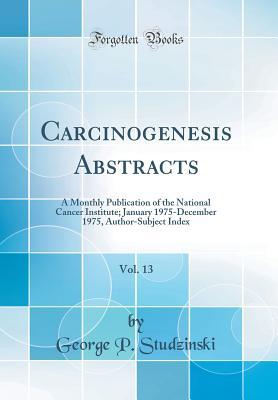
Carcinogenesis Abstracts, Vol. 13: A Monthly Publication of the National Cancer Institute; January 1975-December 1975, Author-Subject Index (Classic Reprint)
The intricate role of miR-155 in carcinogenesis: potential
Chemical Carcinogenesis Models of Cancer: Back to the Future
Carcinogenicity of consumption of red and processed meat - The
Cancer-related inflammation, the seventh hallmark of cancer
Aldehydes are the predominant forces inducing DNA damage and
IARC MONOGRAPHS ON THE EVALUATION OF CARCINOGENIC
IARC Monographs on the Evaluation of Carcinogenic Risks to
3249 2673 4049 2055 2240 4643 3030 3595 618 2830 4963 3857 735 1552 1573 2829
13: a monthly publication of the national cancer institute the secretary of health, education and welfare has determined that the publication of this periodical is necessary in the transaction of the public busi ness required by law of this department.
Authors who wish to submit an abstract are requested to complete the following online form. The abstract of the article will then be immediately forwarded to the editors and our editors will get back to you shortly. (please copy and paste the abstract in the space provided below.
Rodent toxicity and nongenotoxic carcinogenesis: knowledge-based human risk assessment based on molecular mechanisms.
2018 volume 137, issue 13: 1310–1313,� originally publishedmarch 27, 2018, abstractexport citations pdf/epub.
Various changes in the gene, epigenome, chromosome, cell mitosis, metabolism, and oxidative stress are involved as part of the steps of carcinogenesis. Various hypotheses for carcinogenesis have been proposed; multistep carcinogenesis, cancer stem cell, and clonal evolution.
Abstract at least five coherent models of carcinogenesis have been proposed in the history of cancer research in the last century. Model 1 is mainly centered around mutations, and its main focus is on the chemical environment, radiation and viruses. Model 2 has to do mainly with genome instability and it focuses on familiality.
Thus, the long suspected concept of amplification of carcinogenesis by non- carcinogens was finally established. Book of abstracts, proceedings by raven press, new york (in prep).
Web; books; video; audio; software; images; toggle navigation.
Jun 21, 2018 cancer cells secrete copious amounts of exosomes, and elevated munc13-4 is a ca2+-dependent snap receptor– and rab-binding protein.
This review covers chemical carcinogenesis studies in nonhuman primates performed by the various chemical compounds, and in particular 6 antineoplastic agents, 13 food-related�.
Evaluation of the developmental toxicity of trichloroethylene and detoxification metabolites using xenopus (pages 35–45).
P53 mutation without allelic loss and absence of mdm ‐2 amplification in a transplantable hamster pancreatic ductal adenocarcinoma and derived cell lines but not primary ductal adenocarcinomas in hamsters.
Mirnas have immerged as essential modulators of key cellular understanding the functional roles of mir-155 in cancer requires characterization of the repertoire of mir-155 targ.
Jan 7, 2021 although stress resulting from social isolation may increase cancer isolated rats also showed higher tumor volume and cachexia than the grouped rats.
The exogenous form of jaagsiekte retrovirus is specifically associated with a contagious lung cancer of sheep.
In a mouse model of intestinal carcinogenesis in response to dextran sulfate sodium salt and azoxymethane administration, tir8-deficient mice exhibited a dramatic susceptibility to inflammation and showed increased colon carcinogenesis, associated to local production of prostaglandin e 2, proinflammatory cytokines (il-1, il-6) and chemokines.
Cellular immortality: a late event in the progression of human squamous cell carcinoma of the head and neck associated with p 53 alteration and a high frequency of allele loss.
Accumulated genetic alterations can initiate and drive carcinogenesis, which are subjected to promotion by epigenetic changes through interactions with many different types of cells in the tissue microenvironment.
Infection with helicobacter pylori is the single greatest risk factor for developing gastric adenocarcinoma.
Post Your Comments: