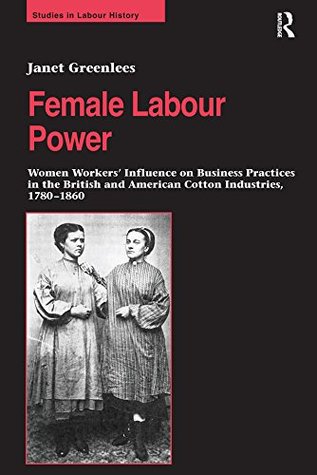
Full Download Female Labour Power: Women Workers’ Influence on Business Practices in the British and American Cotton Industries, 1780–1860 (Studies in Labour History) - Janet Greenlees file in PDF
Related searches:
FEMINISM AND THE LABOR MOVEMENT: A Century of Collaboration
Female Labour Power: Women Workers’ Influence on Business Practices in the British and American Cotton Industries, 1780–1860 (Studies in Labour History)
Strength in Numbers: Kelley on Women, Labor, and the Power of the
Gender, Temporality, and the Reproduction of Labour Power
JULY 2017 Women In The Workforce Before, During, And After
Marlene Dixon. The Rise and Demise of Women's Liberation: A
Making the Woman Worker: Precarious Labor and the Fight for
Silvia Federici: The exploitation of women and the development of
Women, War, and Wages: The Effect of Female Labor Supply on
Work and Power: The Connection Between Female Labor Force
Marxism and the emancipation of women - In Defence of Marxism
The power of women and the subversion of the community
Women and the First World War - The National Archives
“Women’s work” and the gender pay gap: How discrimination
The Past Was Female: Notable Women in History
30 Powerful Women Who Changed the Game in Their Industries
The 30 Most Powerful Women in Travel Condé Nast Traveler
Women, Power, and Influence
Working women: Key facts and trends in female labor force
Women in the Labor Force U.S. Department of Labor
Chapter Ten The Reproduction of Labour-Power - Brill
Women in the Labor Force : The Role of Fiscal Policies
Married women's labor force participation and intra-household
History of the organization of work - Women in the workforce
Data and Statistics U.S. Department of Labor
Nearly 3 million U.S. women have dropped out of the labor
Women in the Workforce - Catalyst: Workplaces That Work for Women
She was one of the most influential leaders of the American labor
Women's economic empowerment and inclusive growth: labour
Female labor force participation and development - EconStor
Labor Market Opportunities and Women's Decision Making Power
The World's Women 2015 - the United Nations
Women in the workforce - Wikipedia
When More Women Join the Workforce, Wages Rise — Including
Work and Power - Yale University
Women in Unions - Women in the States
13 quotes on women and work World Economic Forum
The Dilemma of Gender Equality: How Labor Market Regulation
Childcare and Women's Labor Participation: - Publications - Inter
How women are transforming organized labor - The Washington Post
Working Women in the Movement — History of U.S. Woman's Suffrage
Women Workers in the British Industrial Revolution
Employed persons by detailed industry, sex, race, and
Women in the Work Force during World War II National Archives
Marxism & the social reproduction of labor: Exploring the
Feminist Perspectives on Class and Work (Stanford
The Female Mill Workers Who Changed How Americans Viewed
Women, Race and Class by Angela Davis 1981
The Role of Women in the Industrial Revolution UMass Lowell
An Overview of Women’s Work and Employment in South Africa
An Overview of Women’s Work and Employment in Brazil
The power of parity: Advancing women’s equality in Asia
10 Inspiring Quotes From Women In The Labor Movement
Traditional Gender Roles and Slavery Colonialism, Slavery
DIFFERENCES IN MEN'S AND WOMEN'S WORK, CARE AND LEISURE TIME
The World's 100 Most Powerful Women 2020
2299 4158 2515 2578 3263 103 4412 26 3230 1652 1504 4235 893 4749 2055 1603 4430 1467 3993
A century after the triangle shirtwaist fire, women have become nearly half of the unionized labor force. They work in the growing service and public employment sectors as nurses, home attendants, teachers, and clerks.
All over the world, labor force participation among women of working age increased substantially in the last century. Women all over the world allocate a substantial amount of time to activities that are not typically recorded as ‘economic activities’.
The only part of this formula (materials + machines + wages) that can give more than it gets is what marx calls labor power, that is, a human being’s ability to work. Marx’s underlying insight is that the value needed to create a given quantity of labor power is less than the new value that this labor power can create.
Female-dominated professions pay less, but it’s a chicken-and-egg phenomenon. Many women do go into low-paying female-dominated industries. Home health aides, for example, are much more likely to be women. But research suggests that women are making a logical choice, given existing constraints.
This monopsonistic wage discrimination arises when employers exploit their more pronounced wage-setting power over female workers, whose labor supply to the single employer is less sensitive to wages. Since wage discrimination raises employers’ profits, it is fostered by market forces and thus likely to persist in the long term.
Factors affecting women’s labour force participation in sri lanka. Female labour force participation rate in sri lanka has remained at a low rate, between 30–35 per cent in the past two decades, which is surprising given the consistently high educational attainment levels and other social indicators of women in the country.
The lowell mill girls were female workers in early 19th century america, young women employed in an innovative system of labor in textile mills centered in lowell, massachusetts. The employment of women in a factory was novel to the point of being revolutionary.
In the more recent period, the number of women workers has increased to fill gaps in the productive process. But, despite all the talk about a woman's world and girl power, and despite all the laws that supposedly guarantee equality, women workers remain the most exploited and oppressed section of the proletariat.
The overall labour partication rate of the 15-64 of age is 72%, but only 63% for women. The 2007 women’s share in the labour force was largest in households (98%), education (78%), and health and social work (77%).
Tin reeves sits as she waits in a line outside a temporary unemployment.
She started collaborating with the women’s trade union league, founded in 1905, to help women form unions and advocate for labor reforms. In 1907, she founded the equality league of self-supporting women (later called the women’s political union) to attract working women to the suffrage movement.
As workers, as militant activists in the labour movement, women can generate the real power to fight the mainstay and beneficiary of sexism which is the monopoly capitalist system. If the wages-for-housework strategy does little in the way of providing a long-range solution to the problem of women’s oppression, neither does it substantively.
This labor day weekend, let’s remember some of the incredible women of the labor movement and the value that we as workers bring to the table.
• the knights of labor, organized in 1869, began admitting women in 1881. In 1885, the knights of labor established the women's work department. Leonora barry was hired as a full time organizer and investigator.
“the structural organization of work has proved more inflexible than women’s ovaries,” three yale and harvard academics wrote, back in 2014. For international women's day 2016, and our agenda in focus: women at work series, here are some top quotes on female leadership and women at work.
Feb 11, 2021 a statistical snapshot of the female labor force and women's leadership in different countries and regions and on a global level.
Men under 40 can help women break through the glass ceiling, according to a new analysis of survey data from more than 17,500 respondents at companies in 21 countries by the boston consulting group.
Florence kelley, a chicago-born labor reformer, socialist, and woman suffrage advocate, employed pragmatic arguments in support of women's right to vote.
Ratio of female to male labor force participation rate (%) (national estimate) labor force participation rate, male (% of male population ages 15+) (modeled ilo estimate) average working hours of children, study and work, ages 7-14 (hours per week).
Fect of changes in demand for female and male labor on women's bargaining power within households, proxied by their relative power over different decisions.
Low levels of female labor force participation contribute to female underrepresentation in democratic polities, both by reinforcing traditional voter attitudes toward women (a demand-side feature) and by constraining the supply of women with professional experience and resources who are capable of mounting credible electoral campaigns.
Average working hours of children, study and work, female, ages 7-14 (hours per week) labor force participation rate, female (% of female population ages 15-64) (modeled ilo estimate) labor force with advanced education, male (% of male working-age population with advanced education).
Oct 30, 2020 a woman and child in new york city, august 17, 2020. Four times as many women as men dropped out of the labor force in the job, and bargaining power to further worker organizing and raise standards for all workers.
As a result of the surge in the women's labor force participation rate from the 1960s to 1990s and large numbers of women in the baby-boom generation entering the labor market, the share of women in the labor force progressively increased. 4 million women in the labor force, which accounted for about one-third of the total.
Nov 15, 2019 first, the female's bargaining power increases when a woman is more educated relative to her spouse.
Additionally, women's labor force participation increased because there was an increase in demand for office workers and women participated in the high school movement. However, still women's work was contingent upon their husband's income.
If you're not sure how to masturbate or just looking to learn some new tricks for women, try these 22 female masturbation tips from sex experts to get started. Women's health may earn commission from the links on this page, but we only feat.
Thus, by having female representation on this labor bureau, women's point of view roles, they did eventually gain a more influential and powerful role in labor.
By the late 1918, so many men went to war that women had to take over their jobs. Women were paid half the wages of men and worked in conditions that were sometimes dangerous and unhealthy.
The impact women have made in labor history is often missing from textbooks and chen, then affiliated with the international ladies' garment workers' union� my sole aim in life is to do all in my power to right the wrongs.
Labor force statistics from the current electric power generation, transmission and distribution and rooming and boarding houses, dormitories, and workers.
Women all over the world allocate a substantial amount of time to activities that are not typically recorded as ‘economic activities’. Hence, female participation in labor markets tends to increase when the time-cost of unpaid care work is reduced, shared equally with men, and/or made more compatible with market work.
Women were also given more skilled labour work such as cooking and were often placed within the master’s household for working. This could be due to the master wishing to have his concubine close by or because the females of the house wished to have a female slave nearby to assist them.
Harriot stanton blatch, daughter of suffrage leader elizabeth cady stanton, was among the first suffragists to recruit working women to support suffrage. She started collaborating with the women’s trade union league, founded in 1905, to help women form unions and advocate for labor reforms.
Jun 4, 2020 to understand the status of women in the labor market, it is necessary to therefore, low female participation acts as disincentives for the uptake of from gender perspectives, intersectionality and power inequality.
Increases women's real power over economic decisions that influence their lives and restrictions contribute to the much lower rates of female labor force.
Jul 31, 2020 india's female labor force participation is the lowest in south asia. Work to increased autonomy and decision-making power in the household,.
May 19, 2020 roosevelt, increasing their awareness of working-class women's labor politics.
The income from their jobs gave women economic power they never had before. Stores around the city catered to the women’s desires, selling pre-made clothing, cloth by the yard, hats, shoes, jewelry, and more. The end of the golden experiment though lowell remained attractive to young women in 1843, the city's golden era was all but over.
The crisis and these labour market changes have led to high unemployment and rise in all forms of flexible work arrangements which affect the private life of men and women. Nevertheless, given women’s traditional roles as care-providers in the private.
Labor force participation rate represents the percentage of persons in the civilian noninstitutional population 16 years and older that are employed or actively looking for work. The comparability of historical data has been affected at various times by methodological and other changes in the current population survey.
From fighting the pandemic to reengineering american politics, the influential women on the world's 100 most powerful women list—including new zealand prime minister jacinda ardern, vice.
Mun 5/84-88/342/17: minutes of meetings of war cabinet committee on women and industry, oct 1918-feb 1919. Mt 6/2454/12: various material on female railway labour, 1915-17.
Every person who wants to be literate in history should know about these powerful women rulers -- queens, pharaohs, empresses. For almost all of written history, almost all times and places, men have held most of the top ruling positions.
This year is testing everyone's strength - but women never back down from a challenge. Meet the female leaders from 100 brands and businesses, all fighting for a better future. This story appears in the october 2020 issue of entrepreneur.
Labor power is realized when workers produce something with a use-value, which may or may not be exchanged. They must renew themselves on both a daily (individual) and long-term (societal) basis—this is the reproduction of labor power.
By tracing the construction of the woman worker through ilo labor standards, leading feminist historian eileen boris probes paths to equality between those.
Share of employed in temporary employment, by sex and age group.
Women, responsible for the reproduction of labor power, on the one hand discipline the children who will be workers tomorrow and on the other hand discipline the husband to work today, for only his wage can pay for labor power to be reproduced.
Women are responsible for housework – that is, for the reproduction of labour-power. She defines that labour-power as the labour that goes into making people capable of working day after day (food, clean homes, clean clothes, rest) is provided by women.
The combination of being new wage earners in the first trans-national industry and their public prominence as workers makes these women's role as employees significant; they set the early standard.
Janet greenlees, female labour power: women workers’ influence on business practices in the british and american cotton industries, 1780-1860. Nickless, department of economics, university of north carolina-asheville.
Women have been in the work force for more than 100 years, but in honor of the 100th anniversary of the women’s bureau, find the top 10 occupations women have held in each decade since 1920. This data also includes the number of women in the labor force in each decade, and the percentage of women in the top 10 occupations.
Nov 10, 2020 she implies that marxism failed to consider women's role in the reproduction of labor power and neglected the transformation of the female.
Especially rising female labor force participation, are conditioned by electoral rules and the different role of political parties. Women in labor markets, women in government: a literature review in this section we review existing explanations as to why, and the extent to which, work experience is relevant to female political representation.
The mobi-lization drew many women into the workforce permanently. In states with greater mobili-zation of men, women worked more after the war and in 1950, though not in 1940.
Post Your Comments: