Read Rheology of Particulate Dispersions and Composites - Rajinder Pal file in PDF
Related searches:
Understanding the Links Between Rheology and Particle
Rheology of Particulate Dispersions and Composites
Rheological Properties and Small-Angle Neutron Scattering of a
The Rheology of Colloidal and Noncolloidal Food Dispersions
Rheology of Particulate Dispersions and Composites - 1st
Rheology of Particulate Dispersions and Composites Taylor
Rheology of Particulate Dispersions and Composites (Rajinder
Understanding and Controlling the Rheology of Particulate
Rheology and microstructure of bimodal particulate
Rheology and Filling Characteristics of Particulate
Rheology of concentrated protein solutions and attractive colloidal
Suspension Stability; Why Particle Size, Zeta Potential and - NET
Phase and Rheological Behavior of High-Concentration Colloidal
Rheology of Particulate Dispersions and Composites by
Viscosity and Rheology SpringerLink
The Rheology of Oxide Dispersions and the Role of
The rheology and roll-to-roll processing of shear-thickening
Wiley: Rheology of Dispersions: Principles and Applications
A Study of the Influence of Interparticle Interactions and
Rheology of dispersions : principles and applications in
Download Rheology Of Dispersions Book PDF Epub Mobi Tuebl and
Rheometry and detection of apparent wall slip for Poiseuille
Suspension stability; Why particle size, zeta potential and
Control of Morphological and Rheological Properties of Carrot
(PDF) Control of Morphological and Rheological Properties of
Dispersion and rheology for direct writing lead‐based
(PDF) Rheology of sterically stabilized dispersions and
Structure and rheology of the defect-gel states of pure and
3757 2393 4539 429 4957 1442 335 3692 520 4777 4240 1381 4109 76 2760 2299 3905 3446 4272 3991 4011 49 3642 3814 3186 2902 4029
Rheology to guide formulation development of particulate dispersions for automated capsule filling. In: aps pharmsci 2014, 2014-09-08 - 2014-12-10, university of hertfordshire.
At low polymer concentrations, the dispersions are predominantly viscous at low shear stresses. The phase angle decreases significantly over a narrow shear stress range and the rheology tends to more elastic behavior. At higher shear stresses, the dependence on particle morphology is weak.
Annual transactions� volume 23, 2015� papers presented at the nordic rheology conference, karlstad, sweden, august 19 - 20, 2015� general papers and papers from the special session on particulate and fibrous dispersions subject: gothenburg, reproservice chalmers, 2015 keywords: signatur des originals (print): zl 1015(23).
A comprehensive review of the fundamental rheology of dilute disperse systems is presented. The exact rheological constitutive equations based on rigorous single-particle mechanics are discussed for a variety of disperse systems. The different types of inclusions (disperse phase) considered are: rigid-solid spherical particles with and without electric charge, rigid-porous spherical particles.
Specializes in standard and custom pigment dispersions for pultrusion, smc, bmc, rtm, and spray-up/hand lay-up.
Steric stabilization is a method that is often used to properly disperse small particles. The rheological properties of sterically stabilized dispersions are discussed here.
The six parts are adding complexity step by step starting out from an (1) introduction, (2) rheology of dispersion of rigid particles, (3) rheology of dispersion of non-rigid particles, to (4) rheology of composites, and finally (5) linear viscoelasticity of particulate dispersions and composites.
A dispersion is a system of unmixable phases in which one phase is continuous and at least one is finely distributed.
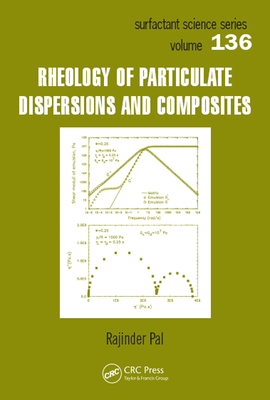
Rheology of particulate dispersions and composites provides comprehensive coverage of fundamental principles and equations that govern the rheology for particulate dispersions and two-phase solid composites.
The shear flow of non-brownian glass spheres suspended in a concentrated colloidal dispersion that exhibits non-newtonian rheology is investigated.
Lactose/poloxamer dispersions were prepared by mixing under vacuum to achieve a de-aerated mix with good capsule filling properties and disperse phase.
1990 linear rheology of viscoelastic emulsions with interfacial-tension�.
Rheology of systems with “soft” or electrostatic interaction.
Rheology and filling characteristics of particulate dispersions in polymer melt formulations for liquid fill hard gelatin capsules.
Jun 4, 2013 we explain the rheological properties of suspensions and how particle characteristics are controlling factors in suspensions.
A dispersion is a system of unmixable phases in which one phase is continuous and at least one is finely distributed. Examples are found in many industrial applications, including emulsions, suspensions, foams, and geld. The control of their flow characteristics - rheology - is essential in their.
A general model of the viscosity of complex-shaped particle dispersions is developed based on an exact virial expansion about the low concentration limit and a mathematical analogy between the hydrodynamics of concentrated particle suspensions and the problem of calculating the conductivity of a suspension of insulating particles in a conductive matrix.
Interpretation of rheological measurements on colloidal dispersions. The object is to structure of flocculated systems (flocs, agglomerates, particle gels; their.
This project has the goal of providing experimental evidence for the influ- ence of interparticle surface forces and hydrodynamic forces (due to the presence of the solvent) on the moderate to high shear rheological properties and shear stability of dispersions that span the colloidal to particulate range (colloidal dispersions to slurries).
Rheology of suspensions and colloidal dispersions when compared to shear. (2010) studied the extensional rheology of corn starch in water suspensions using filament stretching extensional rheometer (fiser) and capillary breakup exten-sional rheometer (caber), to investigate the mechanism of strain hardening.
Rheology of particulate dispersions and composites (rajinder pal) appl. 21:2 (2011) 75-75 cite this publication as follows: fischer p: rheology of particulate dispersions and composites (rajinder pal), appl. Juan de vicente, roque hidalgo-alvarez second international soft matter conference 2010 - ismc2010 appl.
A dispersion is a system of unmixable phases in which one phase is continuous and at least one is finely distributed. Examples are found in many industrial applications, including emulsions, suspensions, foams, and geld. The control of their flow characteristics - rheology - is essential in their preparation, long-term physical stability and application.
For a dispersion of solid drug particles in the excipient, the rheology is affected by the properties of the disperse phase (particle size, concentration) and the continuous phase (viscosity), leading to filling limitations. The aim of this work was to investigate the rheological characteristics of particulate formulations to guide.
Tadros, 9783527320035, available at book depository with free delivery worldwide.
Rheology of particulate dispersions and composites provides comprehensive coverage of fundamental principles and equations that govern the rheology for particulate dispersions and two-phase solid composites. The rheological properties of suspensions, emulsions, bubbly liquids (foams) and other dispersions appear alongside those of solid comp.
Dec 4, 2017 rheology topic of physical pharmacy which covers the types of flow. It is one of the important formulation parameter which will give clear idea.
Part ii completes a study on the effects of particle shape on colloid rheology. A model system of industrial relevance is characterized and studied. Rheology and neutron scattering under flow show that the mechanisms of reversible shear thickening in concentrated colloidal dispersions of ellipsoidal shaped particles are identical to that in colloidal dispersions of spherical particles.
We present a model for the rheological behaviour of non-dilute suspensions of initially spherical viscoelastic particles in viscous fluids under uniform stokes flow.
Executive summary: this project has the goal of providing experimental evidence for the influence of interparticle surface forces and hydrodynamic forces on the moderate to high shear rheological properties and shear stability of wet dispersions that span the colloidal to particulate range.
Many food materials consist of concentrated dispersions of one or more particulate phases in which at least one of the disperse phases is deformable. Typical examples would include mayonnaise, whipped cream, soups and pasta in which air cells, oil droplets and gelatinised starch granules represent the deformable particles.
Aug 23, 2017 we investigate the effects of geometric order and fluid rheology on the dispersion of micron-sized particles in two-dimensional microfluidic porous.
Rheology of particulate dispersions and composites (surfactant science book 136) nov 22, 2006. Rheology of particulate dispersions and composites provides comprehensive coverage of fundamental principles and equations that govern the rheology for particulate dispersions and two-phase solid composites. The rheological properties of suspensions, emulsions, bubbly liquids (foams) and other dispersions appear alongside those of solid comp.
When the fluid is forced through a tube, the particles which compose the fluid generally move more quickly near the tube's axis and more slowly near its walls;.
For a particulate fluid of identical particles (same shape, size, and internal constitution), the rheological.
The rheology of flocculated mineral tailings has impor-tant implications for sustainable mineral processing. It pro-vides tools for assessing thickened tails’ consolidation, transportation and geotechnical characteristics, since both time dependent microscopic and macroscopic particle interactions-mediated flow behaviour can be monitored.
Studies on the flow characteristics of particulate dispersion systems in relation to their coagulation structures.
Rheology-related problems encountered during capsule filling 50can include spatter and dripping for a dispersion of� solid drug particles in the excipient, the rheology is affected by the properties of the disperse phase (particle size, concentration) and the continuous phase (viscosity), leading to filling limitations.
Rheology of dispersions at different ph at lower ph’s particles associate more causing an increase in viscosity. 97 low ph samples show no viscosity plateau suggesting solid like behaviour at rest measurements repeatable on loaded sample suggesting reversible flocculation due to secondary minimum.
Jun 28, 2006 the rheology and shear-induced microstructure of shear thickening studying nanosized particle dispersion rheology probes inter- particle.
Solid drug particles in the excipient, the rheology is affected by the properties of the disperse phase (particle size, concentration) and the continuous phase (viscosity), leading to filling limitations. The aim of this work was to investigate the rheological characteristics of particulate formulations to guide.
Viscosity and rheology are often confused in the literature although they are significantly different concepts. The viscosity of a fluid or suspension is an indication of its fluidity. “heavy” or “thick” fluids such as heavy oils, or molasses, are recognized as those having high viscosity.
Multiphase particulate systems in turbulent flows: fluid-liquid and solid-liquid dispersions provides methods necessary to analyze complex particulate systems and related phenomena including physical, chemical and mathematical description of fundamental processes influencing crystal size and shape, suspension rheology, interfacial area of drops and bubbles in extractors and bubble columns.
The flow properties of three aqueous polyurethane dispersions are characterized as a function of particle concentration. Using a series of simplified methods pioneered on model suspensions, particle interaction energies capable of describing osmotic pressure, continuous shear, and elastic behavior are developed. Electrostatic forces dominate particle interactions at low volume fractions.
The rheology of a suspension or dispersion relates directly to many parameters of commercial interest.
Dispersion is a process by which (in the case of solid dispersing in a liquid) agglomerated particles are separated from each other, and a new interface between the inner surface of the liquid dispersion medium and the surface of the dispersed particles is generated. This process is facilitated by molecular diffusion and convection.
We observe signicant deviations in micro-structure and thermodynamics from isotropic particles at modest particle concentrations.
Cohesion, cohesivity and crosslinking all play a part but can be difficult to measure. Targeting key rheological properties such as modulus, shear thinning and yield.
Understanding the rheology of formulations is important for tuning the formulation for optimal processing. This thesis presents investigations on the rheology of particle dispersions and their impact on roll-to-roll technologies. Shear-thickening behavior is common in particle dispersions, particularly, concentrated particulate inks.
The other hand, polymer binders and thickeners are often added to aqueous dispersions of functional dispersed particulate material to improve the physical stability and aesthetic appearance (‘thick and creamy’).
Rheology of particulate dispersions and composites provides comprehensive coverage of fundamental principles and equations that govern the rheology for particulate dispersions and two-phase solid composites. The rheological properties of suspensions, emulsions, bubbly liquids (foams) and other dispersions appear alongside those of solid composite materials for the first time in this unique, single source.
Several foods contain microscopic particles that are 10 µm and up to approximately 100 µm (for example,.
This paper presents the combined technologies, rheology, zeta potential and particle size measurements, that are important to characterize particle.
The ‘cell-fragment’ dispersion was pre- pared by further shearing of the cooked blended carrot rheology measurements dispersion. %) was added to the dispersions to prevent microbial growth during the 1 week the rheological measurements on the dispersions were analysis period.
Be a region of shear thinning at lower and higher shear rates. Usually dispersions or particulate suspensions with high concentration of solid particles exhibit shear thickening. Materials exhibiting shear thickening are much less common in industrial applications than shear thinning materials.
Read rheometry and detection of apparent wall slip for poiseuille flow of polymer solutions and particulate dispersions by nuclear magnetic resonance velocimetry, journal of rheology on deepdyve, the largest online rental service for scholarly research with thousands of academic publications available at your fingertips.
Here, we examine the influence of particle shape and concentration on the viscosity of these same nanofluids and compare data to predictions from classical.
This equation, however, is only applicable to very dilute dispersions where particle-particle interaction and other surface effects like polymer-particle bridging can be neglected. To account for these interaction, a third term has to be added to the einstein equation:6.
Significantly over a narrow shear stress range and the rheology tends to more rheology-carbon black dispersions.
The rheology zoo is an educational effort to accelerate understanding of rheology and particle chaining in viscoelastic liquid (concentrated soap solution with.
Jun 15, 2020 in this webinar one of our rheology experts, philip rolfe, will introduce the particle size, surface charge and shape of particles in a sample.
In addition, the cavitation process does not modify particle morphology and the influence of particulate shape on rheology can thus be prescribed. Easy to apply when combined with innovative formulations, the ability to uniformly disperse small solid phases into the final matrix yields materials that deposit more smoothly and uniformly.
The dominant contribution to the rheology comes from this defect network in an otherwise well-oriented phase [9], not from a polydomain averaging of the smectic elasticity, as suggested by [10]. E ect of particulate additives: suspending micron size particles had a dramatic e ect on the structure and rheology.
We study the concentration and temperature dependent rheology of concentrated dispersions of these particles. Several features emerge, including a marked dependence of the yield strain on temperature as well as aging of the complex viscosity over time.
The transport properties of particle dispersions are characterised by the rheological properties. It is well known that particle dispersion rheology is strongly influenced by particle-particle interaction forces, and that particle-particle interactions are strongly influenced by adsorbed ions on the particle surfaces.
They comprise solids in the form of the particles, air between the particles, and often water on the surface of, or within the particle.
Post Your Comments: